
Your Health, We Care


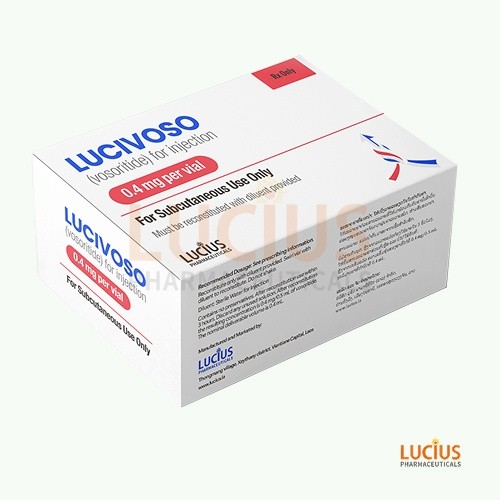
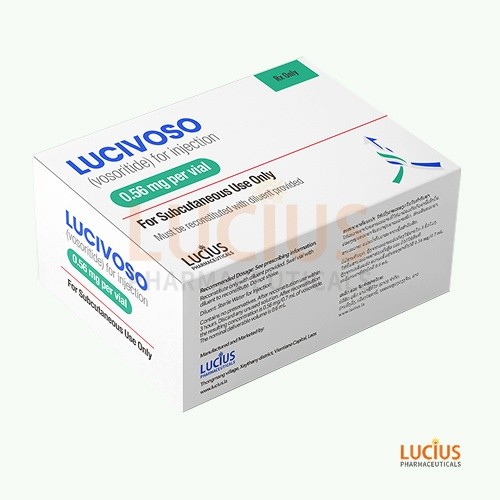
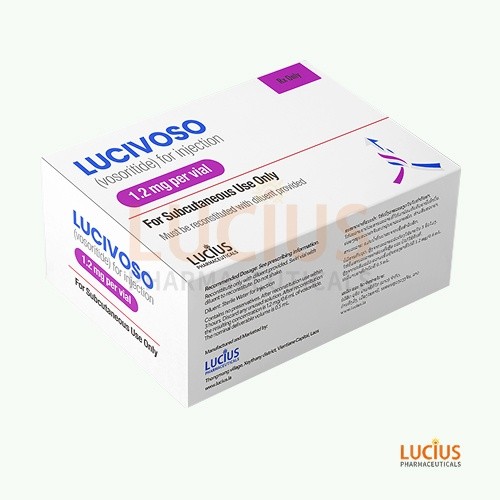
Another NameVoxzogo、伏索利肽
IndicationsTo increase linear growth in pediatric patients with achondroplasia who have open epiphyses.
Specs


Telegram name: Vira
Name: LUCIUS
No.:0085253923643
Vosoritide (LuciVoso) is a C-type natriuretic peptide (CNP) analogue, a recombinant polypeptide consisting of 39 amino acids, administered subcutaneously once daily, for increasing linear growth in pediatric patients with achondroplasia who have open epiphyses.
Reconstitute using the sterile water for injection pre-filled syringe provided in the package. First, remove the vial and diluent from the refrigerator and allow them to warm to room temperature; attach the diluent needle to the pre-filled syringe; inject the entire contents of the diluent into the vial; gently swirl until the white powder is completely dissolved; do not shake. The reconstituted liquid should be clear and colorless to pale yellow; do not use if discolored, cloudy, or containing particles.
Must be used within 3 hours after reconstitution, at room temperature; do not refrigerate the reconstituted product for later use.
Note: Discard any remaining liquid; do not pool remaining liquid from multiple vials, do not withdraw two doses from one vial, and do not mix with other drugs.
Middle anterior thigh, lower abdomen (at least 5 cm from the umbilicus), upper buttock, posterior upper arm. Do not use the same injection area on two consecutive days; rotate to another site; do not inject into areas that are red, swollen, or tender. Syringes and needles are for single use only; dispose of them in a puncture-resistant container after use.
Subcutaneous injection, once daily; try to inject at the same time each day.
The recommended dose is determined by the bracket into which the patient's actual body weight falls. For weights between brackets, round to the nearest whole kilogram.
3 kg corresponds to 0.096 mg, inject 0.12 mL;
4 kg corresponds to 0.12 mg, 0.15 mL;
5 kg corresponds to 0.16 mg, 0.2 mL;
6 to 7 kg corresponds to 0.2 mg, 0.25 mL;
8 to 11 kg corresponds to 0.24 mg, 0.3 mL;
12 to 16 kg corresponds to 0.28 mg, 0.35 mL;
17 to 21 kg corresponds to 0.32 mg, 0.4 mL;
22 to 32 kg corresponds to 0.4 mg, 0.5 mL;
33 to 43 kg corresponds to 0.5 mg, 0.25 mL;
44 to 59 kg corresponds to 0.6 mg, 0.3 mL;
60 to 89 kg corresponds to 0.7 mg, 0.35 mL;
90 kg and above corresponds to 0.8 mg, 0.4 mL.
There must be adequate food intake before administration, and approximately 240 to 300 mL of water should be drunk within 1 hour before injection. The purpose is to reduce the risk of transient blood pressure decrease.
If a dose is missed, it may still be given within 12 hours after the scheduled time; if more than 12 hours have passed, skip it and give the next dose according to the original schedule; do not give two doses on the same day to make up for the missed dose.
Permanently discontinue treatment when epiphyseal closure is confirmed and there is no potential for further growth.
Pregnancy: No available data in pregnant women.
Lactation: Weigh the benefits of breastfeeding together with the mother's treatment need and the potential effects of the drug on the breastfed infant.
Assess weight, growth, and physical development every 3 to 6 months, and adjust the dose according to the new actual body weight. Dosing is not once and for all—each time the child gains a few kilograms, the dose bracket must move up one step.
None.
The most common are injection site reactions: erythema 75%, swelling 62%, wheals 25%; in addition, vomiting 27%, arthralgia 15%, diarrhea 10%, dizziness 10%, ear pain 10%, influenza-like symptoms 10%, fatigue 8%, seasonal allergy 7%, dry skin 5%.
Elevated alkaline phosphatase.
Transient blood pressure decrease.
The root cause of achondroplasia is a gain-of-function mutation in the FGFR3 gene. This mutation keeps the "brake" on endochondral ossification continuously applied, inhibiting chondrocyte proliferation and differentiation, so long bones cannot grow.
Vosoritide (LuciVoso) uses another pathway. It binds to natriuretic peptide receptor B (NPR-B) and inhibits ERK1/2 phosphorylation at the RAF-1 level, thereby counteracting downstream FGFR3 signaling.
At therapeutic concentrations, Vosoritide (LuciVoso) neither inhibits nor induces cytochrome P450 enzymes, and it is unlikely to produce clinically relevant inhibition of transporters such as OAT1, OAT3, OCT1, OCT2, OATP1B1, OATP1B3, MATE1, MATE2-K, BCRP, P-gp, and BSEP. Therefore, mechanistically, it is unlikely to change the concentrations of other drugs.
Pediatric patients receiving antihypertensive drugs were excluded from trials; concomitant use may lower blood pressure further.
No clinical drug interaction studies have been conducted with Vosoritide (LuciVoso).
Telegram name: Vira
Name: LUCIUS
No.:0085253923643
