
Your Health, We Care


Another NameXphozah、替那帕诺、万缇乐
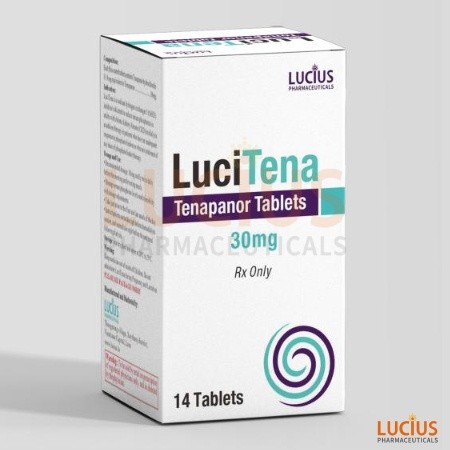
IndicationsTenapanor (LuciTena) is indicated to reduce serum phosphorus levels in adult patients with chronic kidney disease (CKD) receiving dialysis.
Specs


Telegram name: Vira
Name: LUCIUS
No.:0085253923643
Tenapanor (LuciTena) is a sodium/hydrogen exchanger 3 (NHE3) inhibitor that can be used as monotherapy or in combination with phosphate binders.
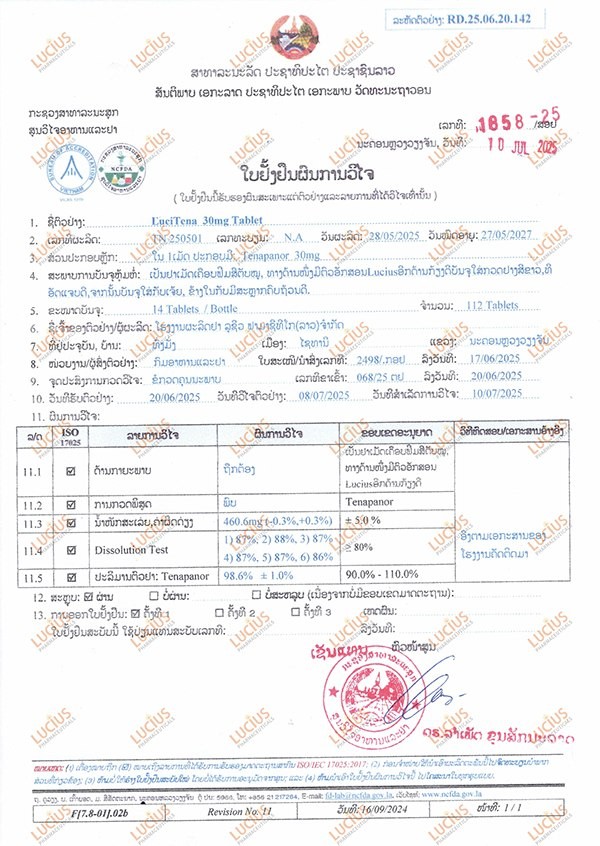
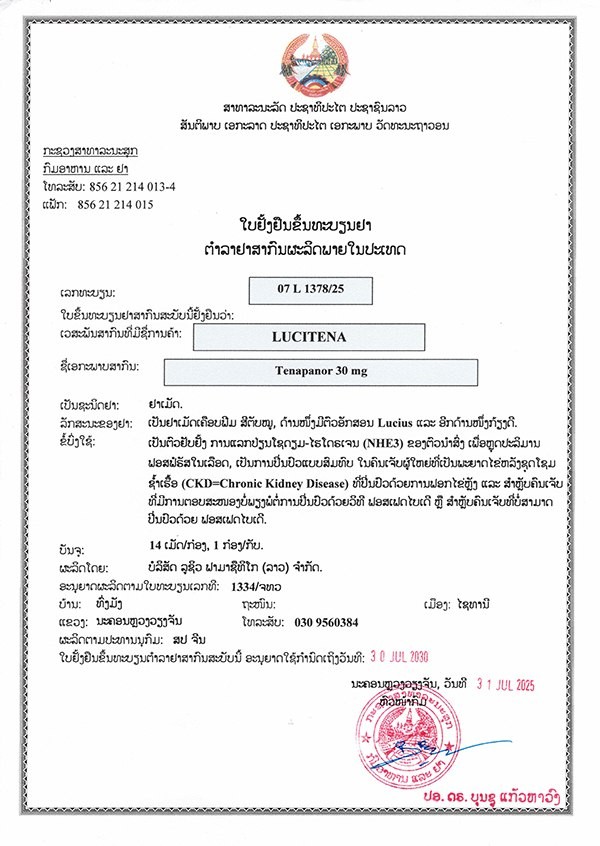
Serum phosphorus levels should be monitored, and the dose should be adjusted as needed to manage gastrointestinal tolerability. The goals of dose adjustment encompass both serum phosphorus control and gastrointestinal tolerability.
Tenapanor (LuciTena) should be taken immediately before the first meal (breakfast) and the last meal (dinner) of the day.
Tenapanor (LuciTena) should not be taken immediately before hemodialysis treatment; instead, it should be taken immediately before the next meal after dialysis, because diarrhea may occur after patients take Tenapanor (LuciTena).
The dosing schedule is based on the finding that taking Tenapanor (LuciTena) 5 to 10 minutes before a meal increases 24-hour fecal phosphorus excretion compared with taking it after a meal or on an empty stomach. Therefore, Tenapanor (LuciTena) should be tied to meal times and should not be taken on an empty stomach or after a meal.
The recommended dosage is 30 mg orally twice daily, taken before the morning and evening meals.
Tenapanor (LuciTena) can be used as monotherapy or in combination with phosphate binders.
If a dose is missed, the missed dose should be skipped, and the next dose should be taken at the regular time before the next meal. Do not take two doses at the same time.
Tenapanor (LuciTena) should be discontinued in patients with severe diarrhea. For mild to moderate diarrhea, events mostly resolve over time or with dose reduction; dose reduction may be considered.
Geriatric patients, patients with hepatic impairment, and patients with renal impairment: no specific dosage recommendations.
Tenapanor (LuciTena) is minimally absorbed systemically, with plasma concentrations below the lower limit of quantification (<0.5 ng="">
Tenapanor (LuciTena) and its major metabolite M1 were not detected in the breast milk of lactating women.
Consider the benefits of breastfeeding for infant development and health, the mother's clinical need for Tenapanor (LuciTena), and any potential adverse effects of Tenapanor (LuciTena) or the mother's underlying disease on the breastfed infant.
Tenapanor (LuciTena) is contraindicated in patients under 6 years of age.
Clinical studies of Tenapanor (LuciTena) did not include a sufficient number of patients aged 65 years and older to determine whether they respond differently from younger patients.
In subjects with normal hepatic function and moderate hepatic impairment, Tenapanor (LuciTena) showed minimal systemic bioavailability, with plasma concentrations below the lower limit of quantification (<0.5 ng="">
In CKD patients receiving dialysis (estimated glomerular filtration rate [eGFR] below 15 mL/min/1.73 m²), steady-state plasma concentrations of M1 were not significantly different from those in healthy subjects receiving similar doses of Tenapanor (LuciTena).
Tenapanor (LuciTena) is contraindicated in pediatric patients under 6 years of age due to the risk of diarrhea and severe dehydration.
Tenapanor (LuciTena) is contraindicated in patients with known or suspected mechanical gastrointestinal obstruction.
Tenapanor (LuciTena) acts locally in the intestine, and amplification of its pharmacologic effect can lead to gastrointestinal adverse reactions; diarrhea is the most common adverse reaction in patients treated with Tenapanor (LuciTena). If diarrhea is severe or prolonged, there is a risk of dehydration.
Monitor patients for the occurrence and severity of diarrhea, and assess volume status and electrolytes when diarrhea occurs; Tenapanor (LuciTena) should be discontinued in patients with severe diarrhea, and patients should be instructed to contact their healthcare provider. For mild to moderate diarrhea, dose reduction may be considered with continued observation. Tenapanor (LuciTena) should not be used with stool softeners or laxatives.
Most common adverse reaction: diarrhea.
Tenapanor (LuciTena) is an inhibitor of the intestinal uptake transporter OATP2B1. Exposure to drugs that are OATP2B1 substrates may be decreased when coadministered with Tenapanor (LuciTena). Monitor for signs of loss of efficacy and adjust the dose of the concomitant drug as needed.
Tenapanor (LuciTena) inhibits OATP2B1 but is not an inhibitor of P-glycoprotein (P-gp), breast cancer resistance protein (BCRP), OATP1B1, OATP1B3, or PEPT1. M1 does not inhibit P-gp, BCRP, OATP1B1, OATP1B3, OAT1, OAT3, OCT2, MATE1, or MATE2-K. Tenapanor (LuciTena) is not a substrate of P-gp, BCRP, OATP1B1, or OATP1B3; M1 is a substrate of P-gp.
Tenapanor (LuciTena) and M1 do not inhibit CYP1A2, CYP2B6, CYP2C8, CYP2C9, CYP2C19, or CYP2D6 in vitro, and do not induce CYP1A2 or CYP2B6 in vitro. Tenapanor (LuciTena) is primarily metabolized by CYP3A4/5.
CYP3A4 inhibitors: After a single dose of Tenapanor (LuciTena) was coadministered with repeated doses of the CYP3A4 inhibitor itraconazole, the mean AUC and Cmax of M1 decreased in healthy subjects; after coadministration with itraconazole, plasma concentrations of Tenapanor (LuciTena) were mostly below the lower limit of quantification (<0.5 ng="">
In vitro studies suggest that Tenapanor (LuciTena) may bind to sevelamer carbonate, but did not suggest that it may bind to calcium carbonate or calcium acetate.
Tenapanor (LuciTena) and sodium polystyrene sulfonate should be administered at least 3 hours apart. SPS can bind to many commonly used oral medications.
Telegram name: Vira
Name: LUCIUS
No.:0085253923643
