
Your Health, We Care


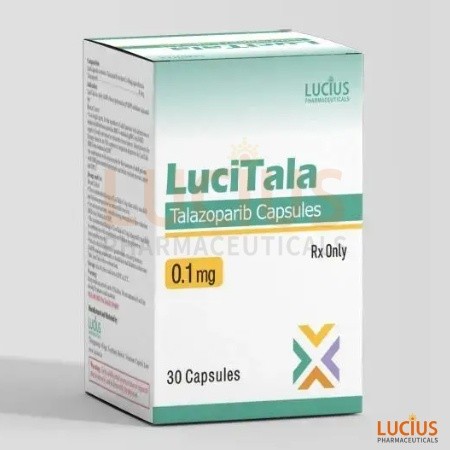
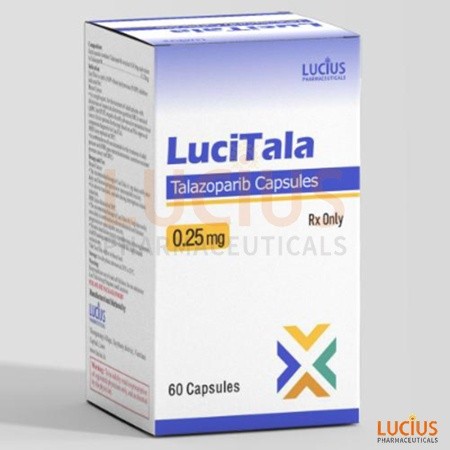
Another NameTalzenna、泰泽纳、他拉唑帕利
IndicationsAs monotherapy for adult patients with deleterious or suspected deleterious germline BRCA-mutated (gBRCAm), HER2-negative locally advanced or metastatic breast cancer; in combination with enzalutamide
Specs


Telegram name: Vira
Name: LUCIUS
No.:0085253923643
Talazoparib (LuciTala) is a poly(ADP-ribose) polymerase (PARP) inhibitor. It is indicated as monotherapy for the treatment of adult patients with deleterious or suspected deleterious germline breast cancer susceptibility gene (BRCA)-mutated, human epidermal growth factor receptor 2 (HER2)-negative locally advanced or metastatic breast cancer; in combination with enzalutamide, it is indicated for the treatment of adult patients with homologous recombination repair (HRR) gene-mutated metastatic castration-resistant prostate cancer (mCRPC), with the relevant gene mutation confirmed by testing before treatment.
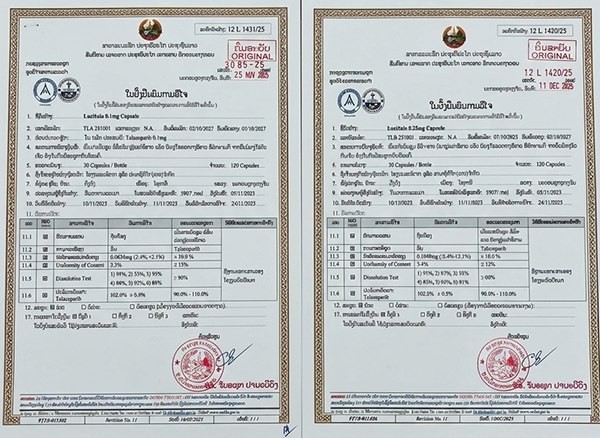
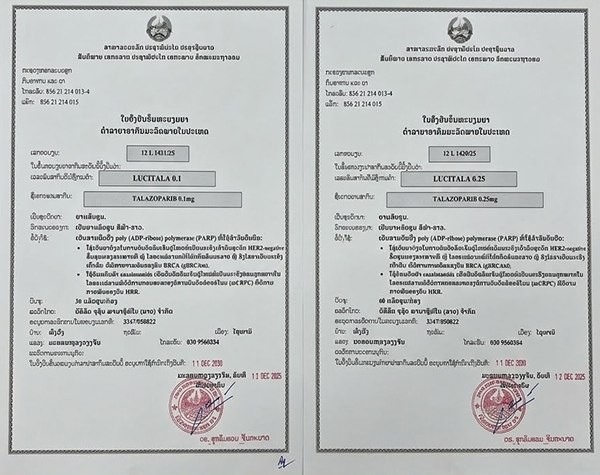
Patients with breast cancer should be selected for treatment based on the presence of a germline BRCA mutation (deleterious or suspected deleterious); patients with metastatic castration-resistant prostate cancer should be selected for treatment based on the presence of alterations in genes directly or indirectly involved in the HRR pathway (ATM, ATR, BRCA1, BRCA2, CDK12, CHEK2, FANCA, MLH1, MRE11A, NBN, PALB2, or RAD51C). For information on FDA-approved genetic mutation testing methods, refer to the agency's published companion diagnostic information. There is currently no FDA-approved test for HRR gene mutation detection that is intended for use with Talazoparib (LuciTala).
Monitor complete blood counts monthly during treatment and as clinically needed. For patients with severe renal impairment, monitor for increased adverse reactions. When used concomitantly with P-glycoprotein inhibitors, monitor for increased adverse reactions.
Talazoparib (LuciTala) may be taken with or without food. Capsules should be swallowed whole and must not be opened or dissolved.
For patients with breast cancer, Talazoparib (LuciTala) is taken once daily; for patients with prostate cancer, Talazoparib (LuciTala) should be taken once daily together with enzalutamide, and treatment with a gonadotropin-releasing hormone (GnRH) analog should be initiated or continued during treatment unless the patient has undergone surgical castration (i.e., bilateral orchiectomy).
Breast Cancer: The recommended dosage of Talazoparib (LuciTala) is 1 mg orally once daily, continued until disease progression or unacceptable toxicity.
Metastatic Castration-Resistant Prostate Cancer: The recommended dosage of Talazoparib (LuciTala) is 0.5 mg orally once daily, administered in combination with enzalutamide, continued until disease progression or unacceptable toxicity. For the recommended dosage of enzalutamide, refer to the enzalutamide prescribing information.
Patients receiving Talazoparib (LuciTala) with enzalutamide should also receive concomitant treatment with a gonadotropin-releasing hormone (GnRH) analog or have undergone bilateral orchiectomy.
If a patient misses a dose of Talazoparib (LuciTala) or vomits after taking a dose, instruct the patient to take the next prescribed dose at the regular time; do not take an additional dose to make up for the missed dose.
Talazoparib (LuciTala) can cause embryo-fetal harm when administered to pregnant women. There are no available data on the use of Talazoparib (LuciTala) in pregnant women to evaluate drug-associated risk. Inform pregnant women and women of reproductive potential of the potential risk to the fetus.
Because Talazoparib may cause serious adverse reactions in breastfed infants, advise lactating women not to breastfeed during treatment with Talazoparib (LuciTala) and for 1 month after the last dose.
Talazoparib (LuciTala) can cause fetal harm when administered to pregnant women. Verify pregnancy status in women of reproductive potential before initiating Talazoparib (LuciTala) treatment. Women of reproductive potential should use effective contraception during treatment with Talazoparib (LuciTala) and for 7 months after the last dose.
Male patients with female partners of reproductive potential or whose partner is pregnant should use effective contraception during treatment with Talazoparib (LuciTala) and for 4 months after the last dose; Talazoparib (LuciTala) may impair fertility in males of reproductive potential.
The safety and efficacy of Talazoparib (LuciTala) in pediatric patients have not been established.
No overall differences in safety or efficacy of Talazoparib (LuciTala) were observed between these geriatric patients and younger patients.
No dose adjustment is required in patients with hepatic impairment.
The recommended dose of Talazoparib (LuciTala) should be reduced in patients with moderate (creatinine clearance [CLcr] 30 to 59 mL/min) and severe (creatinine clearance [CLcr] 15 to 29 mL/min) renal impairment.
Monitor patients with severe renal impairment for increased adverse reactions and adjust the dose according to the recommendations for management of adverse reactions.
No dose adjustment is required in patients with mild renal impairment (creatinine clearance [CLcr] 60 to 89 mL/min). Talazoparib (LuciTala) has not been studied in patients requiring hemodialysis.
Similar increases in AUC were also observed in patients with moderate and severe renal impairment when coadministered with enzalutamide.
Based on the severity of adverse reactions and clinical presentation, consider interrupting Talazoparib (LuciTala) treatment, with or without dose reduction. If more than 3 dose reductions are required, discontinue Talazoparib (LuciTala).
Dose reduction steps for breast cancer: recommended starting dose is 1 mg once daily; first reduction to 0.75 mg once daily; second reduction to 0.5 mg once daily; third reduction to 0.25 mg once daily.
Dose reduction steps for metastatic castration-resistant prostate cancer: recommended starting dose is 0.5 mg once daily; first reduction to 0.35 mg once daily; second reduction to 0.25 mg once daily; third reduction to 0.1 mg once daily.
For hemoglobin <8 g/dL, withhold Talazoparib (LuciTala) and resume at a reduced dose after hemoglobin recovers to ≥9 g/dL.
For platelet count <50,000/μL, withhold Talazoparib (LuciTala) and resume at a reduced dose after platelet count recovers to ≥75,000/μL.
For neutrophil count <1,000/μL, withhold Talazoparib (LuciTala) and resume at a reduced dose after neutrophil count recovers to ≥1,500/μL.
For Grade 3 or 4 non-hematologic adverse reactions, withhold Talazoparib (LuciTala); after recovery to ≤Grade 1, consider resuming at a reduced dose or discontinuing.
For dose adjustments required for adverse reactions related to enzalutamide, refer to the enzalutamide prescribing information.
For patients with breast cancer, avoid concomitant use of Talazoparib (LuciTala) with the following P-glycoprotein (P-gp) inhibitors: itraconazole, amiodarone, carvedilol, clarithromycin, itraconazole, and verapamil.
For patients with metastatic castration-resistant prostate cancer receiving combination therapy with enzalutamide, the effect of P-glycoprotein inhibitors on Talazoparib (LuciTala) exposure has not been studied.
No dose adjustment is required for mild renal impairment (creatinine clearance [CLcr] 60 to 89 mL/min). Talazoparib (LuciTala) has not been studied in patients requiring hemodialysis.
Moderate renal impairment (creatinine clearance [CLcr] 30 to 59 mL/min): the recommended dose for the breast cancer indication is 0.75 mg orally once daily; the recommended dose for the metastatic castration-resistant prostate cancer indication is 0.35 mg orally once daily, administered in combination with enzalutamide.
Severe renal impairment (creatinine clearance [CLcr] 15 to 29 mL/min): the recommended dose for the breast cancer indication is 0.5 mg orally once daily; the recommended dose for the metastatic castration-resistant prostate cancer indication is 0.25 mg orally once daily, administered in combination with enzalutamide.
No dose adjustment is required in patients with hepatic impairment.
Most common adverse reactions (≥20%): decreased hemoglobin, decreased neutrophils, decreased lymphocytes, decreased platelets, fatigue, increased glucose, increased aspartate aminotransferase, increased alkaline phosphatase, increased alanine aminotransferase, decreased calcium, nausea, headache, vomiting, alopecia, diarrhea, and decreased appetite.
Most common laboratory abnormalities (≥25%): decreased hemoglobin, decreased lymphocytes, decreased neutrophils 68%, decreased platelets, increased glucose, increased aspartate aminotransferase, increased alkaline phosphatase, increased alanine aminotransferase, decreased calcium.
Most common adverse reactions (≥10%): decreased hemoglobin, decreased neutrophils, decreased lymphocytes, fatigue, decreased platelets, decreased calcium, nausea, decreased appetite, decreased sodium, decreased phosphate, fractures, decreased magnesium, dizziness, increased bilirubin, decreased potassium, and dysgeusia.
Most common laboratory abnormalities (≥10% and worsening from baseline): decreased hemoglobin, decreased neutrophils, decreased lymphocytes, decreased platelets, decreased calcium, decreased sodium, decreased phosphate, decreased magnesium, increased bilirubin, decreased potassium.
These are not all of the adverse reactions of Talazoparib (LuciTala); other adverse reactions may occur. Consult a physician for specific information.
The major risks identified for Talazoparib (LuciTala) in clinical studies and postmarketing use are myelodysplastic syndrome/acute myeloid leukemia (MDS/AML), myelosuppression, and embryo-fetal toxicity, with some cases of MDS/AML being fatal. Management of these risks is described in the following sections.
MDS/AML is one of the most serious safety risks of Talazoparib (LuciTala), including fatal cases. Myelodysplastic syndrome (MDS) and acute myeloid leukemia (AML) are myeloid clonal hematologic disorders associated with exposure to PARP inhibitor class drugs, and have been reported in patients treated with Talazoparib (LuciTala).
Patients with prior exposure to platinum-containing chemotherapy, radiation therapy, or other DNA-damaging therapies may be at higher risk of developing MDS/AML.
Do not initiate Talazoparib (LuciTala) treatment until patients have adequately recovered from hematologic toxicity caused by prior chemotherapy. Monitor blood cell counts monthly during treatment. For persistent hematologic toxicity, interrupt Talazoparib (LuciTala) and monitor blood cell counts weekly until recovery. If blood cell counts do not recover within 4 weeks, refer the patient to hematology for further evaluation, including bone marrow analysis and blood sample collection for cytogenetic testing. If MDS/AML is confirmed, discontinue Talazoparib (LuciTala).
Talazoparib (LuciTala) can affect hematopoietic function, causing anemia, neutropenia, and/or thrombocytopenia.
Interrupt Talazoparib (LuciTala) before adequate recovery from hematologic toxicity caused by prior treatment. Monitor blood cell counts monthly during treatment. If hematologic toxicity does not resolve within 28 days, discontinue Talazoparib (LuciTala) and refer the patient to hematology for further evaluation, including bone marrow analysis and blood sample collection for cytogenetic testing.
Based on the mechanism of action of Talazoparib (LuciTala) and animal study data, Talazoparib (LuciTala) can cause fetal harm when administered to pregnant women.
Pregnant women and women of reproductive potential are high-risk populations.
Inform pregnant women and women of reproductive potential of the potential risk to the fetus. Advise women of reproductive potential to use effective contraception during treatment with Talazoparib (LuciTala) and for 7 months after the last dose. Based on genotoxicity and animal reproductive study results, advise male patients with female partners of reproductive potential or whose partner is pregnant to use effective contraception during treatment with Talazoparib (LuciTala) and for 4 months after the last dose.
Talazoparib is a substrate of P-glycoprotein (P-gp). P-glycoprotein inhibitors can increase plasma concentrations of Talazoparib, potentially increasing the risk of adverse reactions.
For patients with breast cancer, avoid concomitant use of Talazoparib (LuciTala) with the following P-glycoprotein inhibitors: itraconazole, amiodarone, carvedilol, clarithromycin, itraconazole, and verapamil. If concomitant use cannot be avoided, reduce the Talazoparib (LuciTala) dose; after discontinuation of the P-glycoprotein inhibitor, restore the Talazoparib (LuciTala) dose. When coadministered with a single 0.5 mg dose of Talazoparib (LuciTala), itraconazole increased the area under the curve (AUC) and peak concentration (Cmax) of Talazoparib by approximately 56% and 40%, respectively; concomitant use with other P-glycoprotein inhibitors such as amiodarone, carvedilol, clarithromycin, itraconazole, and verapamil increased Talazoparib exposure by 45%.
When Talazoparib (LuciTala) is used concomitantly with other P-glycoprotein inhibitors, monitor for increased adverse reactions and adjust the dose according to the recommendations for management of adverse reactions. Concomitant use with other P-glycoprotein inhibitors such as azithromycin, atorvastatin, diltiazem, felodipine, fluvoxamine, and quercetin had no clinically significant effect on the pharmacokinetics of Talazoparib.
For patients with metastatic castration-resistant prostate cancer receiving combination therapy with enzalutamide, the effect of P-glycoprotein inhibitors on Talazoparib exposure has not been studied; when used concomitantly, monitor for increased adverse reactions and adjust the dose according to the recommendations for management of adverse reactions.
When coadministered with a single 1 mg dose of Talazoparib (LuciTala), the P-glycoprotein inducer rifampin increased the peak concentration (Cmax) of Talazoparib by 37% and had no effect on the area under the curve (AUC).
Concomitant use with breast cancer resistance protein (BCRP) inhibitors may increase Talazoparib exposure, potentially increasing the risk of adverse reactions. When Talazoparib (LuciTala) is used concomitantly with BCRP inhibitors, monitor patients for increased adverse reactions and adjust the dose according to the recommendations for management of adverse reactions.
Concomitant use with proton pump inhibitors (PPIs), histamine receptor 2 antagonists (H2RAs), or other drugs that reduce gastric acid has no effect on the absorption of Talazoparib.
When enzalutamide is coadministered with Talazoparib (LuciTala), it can increase Talazoparib exposure by approximately 2-fold.
Transporters: Talazoparib is a substrate of P-glycoprotein (P-gp) and breast cancer resistance protein (BCRP) transporters, but is not a substrate of organic anion transporting polypeptide (OATP) 1B1, OATP1B3, organic cation transporter (OCT) 1, OCT2, organic anion transporter (OAT) 1, OAT3, bile salt export pump (BSEP), multidrug and toxin extrusion transporter (MATE) 1, or MATE2-K; Talazoparib is also not an inhibitor of P-glycoprotein, BCRP, OATP1B1, OATP1B3, OCT1, OCT2, OAT1, OAT3, BSEP, MATE1, or MATE2-K.
Metabolic enzymes: Talazoparib is not an inhibitor of cytochrome P450 (CYP) 1A2, CYP2B6, CYP2C8, CYP2C9, CYP2C19, CYP2D6, or CYP3A4/5, and is not an inducer of CYP1A2, CYP2B6, or CYP3A4. Talazoparib is not an inhibitor of uridine diphosphate glucuronosyltransferase (UGT) isoforms (1A1, 1A4, 1A6, 1A9, 2B7, and 2B15).
Telegram name: Vira
Name: LUCIUS
No.:0085253923643
