
Your Health, We Care


Release date: 2026-10-22 16:05:55 Recommended: 8
Capmatinib (Lucicapma) is indicated for non-small cell lung cancer patients with mutations leading to MET exon 14 skipping. The recommended dose is 400 mg orally twice daily, with or without food.
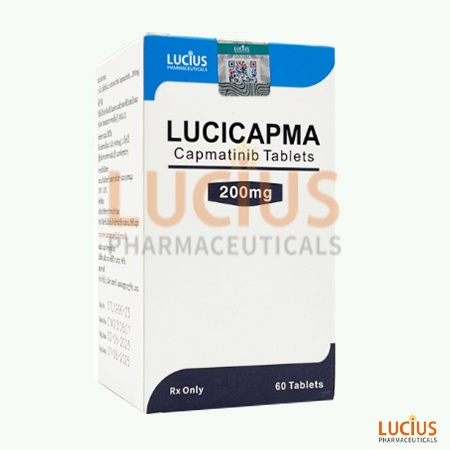
Capmatinib (Lucicapma) 200mg
Capmatinib (Lucicapma) is indicated for the treatment of adult patients with metastatic non-small cell lung cancer (NSCLC) whose tumors have a mutation that leads to mesenchymal-epithelial transition (MET) exon 14 skipping as detected by an FDA-approved test.
Note: This indication is approved under accelerated approval based on overall response rate and duration of response; continued approval for this indication may be contingent upon verification and description of clinical benefit in confirmatory trials.
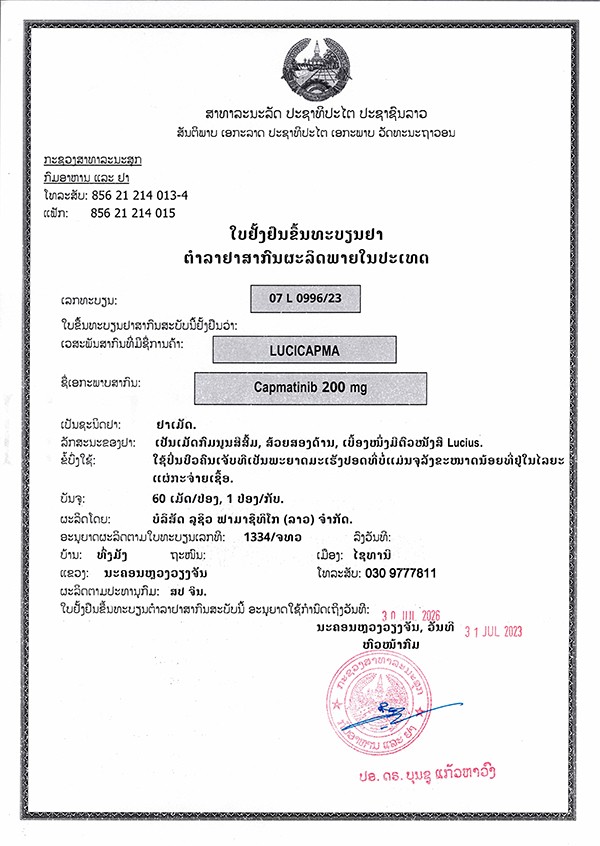
Capmatinib (Lucicapma) Production Approval
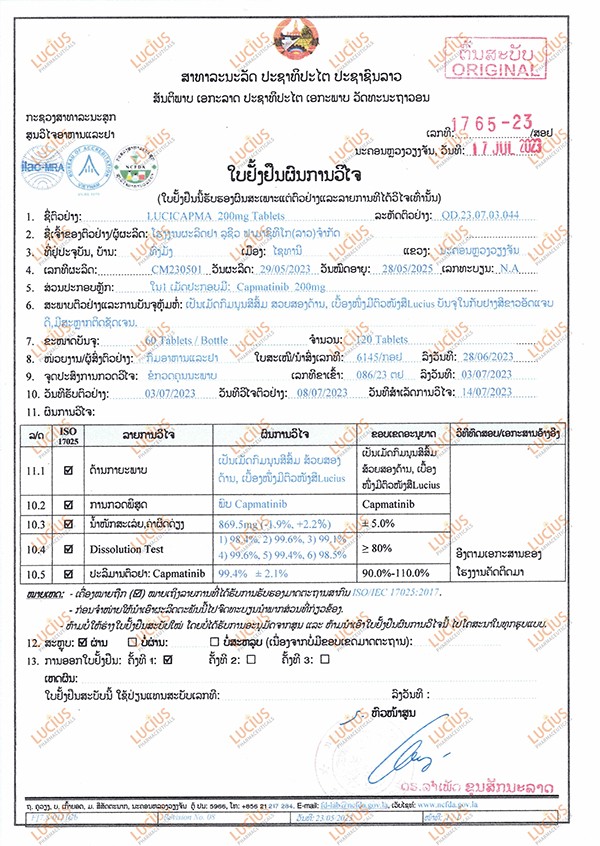
Capmatinib (Lucicapma) Test Report
Select patients for treatment with Capmatinib (Lucicapma) based on the presence of MET exon 14 skipping mutations in tumor specimens.
The recommended dosage of Capmatinib (Lucicapma) is 400 mg twice daily.
Administer orally with or without food. Swallow Capmatinib (Lucicapma) tablets whole. Do not chew, crush, or split the tablets.
Do not take a replacement dose; take the next dose at the scheduled time.
Do not take a replacement dose; take the next dose at the scheduled time.
Risk Summary: Based on findings from animal studies and its mechanism of action, Capmatinib (Lucicapma) can cause fetal harm when administered to a pregnant woman. There are no available data on the use of Capmatinib (Lucicapma) in pregnant women to evaluate for a drug-associated risk. In animal reproduction studies, administration of capmatinib to pregnant rats and rabbits during the period of organogenesis resulted in maternal toxicity and embryo-fetal toxicity at exposures less than the human exposure at the recommended clinical dose of 400 mg twice daily. Advise pregnant women of the potential risk to a fetus. The estimated background risk of major birth defects and miscarriage for the indicated population is 2% to 4% and 15% to 20%, respectively, in the U.S. general population.
Data: In rats, maternal toxicity (reduced food intake and body weight gain) occurred at a dose of approximately 30 mg/kg/day (approximately 1.4 times the recommended clinical dose of 400 mg twice daily, based on AUC). Embryo-fetal toxicity (decreased maternal and fetal body weights, increased incidences of visceral and skeletal anomalies, edema, decreased liver weights, folded umbilical cord, reduced number of phalanges in forelimbs and hindlimbs, and delayed ossification of carpal/tarsal bones) was observed at a dose of approximately 60 mg/kg/day (approximately 2.5 times the clinical exposure).
Risk Summary: There are no data on the presence of capmatinib or its metabolites in human milk, the effects on the breastfed infant, or the effects on milk production. Because of the potential for serious adverse reactions in breastfed infants, advise women not to breastfeed during treatment with Capmatinib (Lucicapma) and for 1 week after the last dose.
Pregnancy Testing: Verify pregnancy status in females of reproductive potential prior to initiating treatment with Capmatinib (Lucicapma). A negative pregnancy test is required.
Contraception: Females: Advise females of reproductive potential to use effective contraception during treatment with Capmatinib (Lucicapma) and for 1 week after the last dose. Males: Advise male patients with female partners of reproductive potential to use effective contraception during treatment with Capmatinib (Lucicapma) and for 1 week after the last dose.
The safety and effectiveness of Capmatinib (Lucicapma) in pediatric patients have not been established.
Of the 334 patients in the GEOMETRY mono-1 study, 57% were 65 years of age or older, and 16% were 75 years of age or older. No overall differences in safety or effectiveness were observed between these patients and younger patients.
No dosage adjustment is recommended in patients with mild (creatinine clearance [CLcr] 60 to 89 mL/min) or moderate (CLcr 30 to 59 mL/min) renal impairment. Capmatinib (Lucicapma) has not been studied in patients with severe renal impairment (CLcr 15 to 29 mL/min).
No dosage adjustment is recommended in patients with mild (total bilirubin ≤ upper limit of normal [ULN] and AST>ULN, or total bilirubin>1 to 1.5 times ULN and any AST) or moderate (total bilirubin>1.5 to 3 times ULN and any AST) hepatic impairment. Capmatinib (Lucicapma) has not been studied in patients with severe hepatic impairment (total bilirubin>3 times ULN and any AST).
The recommended dosage reduction schedule for managing adverse reactions of Capmatinib (Lucicapma) is as follows: the first dose reduction is to 300 mg twice daily; the second dose reduction is to 200 mg twice daily.
The recommended dosage modification schedule for Capmatinib (Lucicapma) for specific adverse reactions is as follows:
1. If interstitial lung disease (ILD)/pneumonitis occurs (any grade): permanently discontinue the drug.
2. If ALT or AST elevation occurs (Grade 3, without an increase in total bilirubin): withhold the drug until recovery to baseline or ≤ Grade 1, then resume at the same dose or resume at a reduced dose (see the dose reduction schedule above). If Grade 4 occurs, permanently discontinue the drug.
3. If ALT or AST elevation occurs (Grade 3, with an increase in total bilirubin but without cholestasis): permanently discontinue the drug.
4. If ALT or AST elevation occurs (Grade 4, regardless of total bilirubin level): permanently discontinue the drug.
5. If ALT or AST elevation occurs (Grade 2, without an increase in total bilirubin): withhold the drug until recovery to baseline or ≤ Grade 1, then resume at the same dose or resume at a reduced dose.
6. If ALT or AST elevation occurs (Grade 3, with an increase in total bilirubin and cholestasis): withhold the drug until recovery to baseline or ≤ Grade 1, then resume at the same dose or resume at a reduced dose; if Grade 4 occurs, permanently discontinue the drug.
7. For other adverse reactions (≥ Grade 2): withhold the drug until recovery to baseline or ≤ Grade 1, then resume at the same dose or resume at a reduced dose; if Grade 4 occurs, permanently discontinue the drug.
(Note: ALT = alanine aminotransferase; AST = aspartate aminotransferase; ILD = interstitial lung disease; ULN = upper limit of normal. Adverse reaction grading is based on NCI CTCAE v4.03)
Because clinical trials are conducted under widely varying conditions, adverse reaction rates observed in the clinical trials of a drug cannot be directly compared to rates in the clinical trials of another drug and may not reflect the rates observed in practice.
The safety of Capmatinib (Lucicapma) was evaluated in 334 patients in the GEOMETRY mono-1 study (an open-label, multi-cohort study in patients with metastatic NSCLC harboring MET exon 14 skipping mutations). Patients received Capmatinib (Lucicapma) 400 mg orally twice daily. 51% and 16% of patients received treatment for at least 6 months and 16 months, respectively. Serious adverse reactions occurred in 51% of patients receiving Capmatinib (Lucicapma). Serious adverse reactions occurring in ≥ 2% of patients included dyspnea (4.2%), pleural effusion (3.3%), pneumonia (2.7%), general physical health deterioration (2.1%), and nausea (2.1%). Fatal adverse reactions occurred in 1% of patients (0.3% was pneumonia). Permanent discontinuation of Capmatinib (Lucicapma) due to adverse reactions occurred in 16% of patients. The most common adverse reactions (≥ 1%) leading to permanent discontinuation were pneumonia (1.8%), fatigue (1.8%), dyspnea (1.8%), and hepatic failure (1.5%). Dosage interruptions due to adverse reactions occurred in 54% of patients who received Capmatinib (Lucicapma). The rate of dose reductions due to adverse reactions in patients who received Capmatinib (Lucicapma) was 44%. The most common adverse reactions (≥ 1%) leading to dose reductions were peripheral edema (8.4%), blood creatinine increased (6.3%), nausea, vomiting, alanine aminotransferase increased, aspartate aminotransferase increased, fatigue, and pneumonia.
In the GEOMETRY mono-1 study, adverse reactions occurring in ≥ 10% of patients treated with Capmatinib (Lucicapma) were as follows: peripheral edema (all grades 52%, grade 3/4 9%), nausea (all grades 44%, grade 3/4 2%), fatigue (32%, 8%), vomiting (28%, 2%), dyspnea (24%, 6%), rash (20%, 1%), decreased appetite (21%, 0%), weight decreased (14%, 0%), diarrhea (14%, 0%), cough (14%, 2%), pyrexia (14%, 1%), constipation (13%, 0%), and dizziness (11%, 0%). Some adverse reactions overlap, for example, peripheral edema includes facial edema, peripheral swelling, eyelid edema, etc.; fatigue includes asthenia, malaise; rash includes generalized rash, maculopapular rash, pruritic rash, etc.
In the GEOMETRY mono-1 study, selected laboratory abnormalities worsening (≥ 20%) in patients treated with Capmatinib (Lucicapma) were as follows: creatinine increased (all grades 68%, grade 3/4 1%), glucose increased (68%, 3%), alanine aminotransferase (ALT) increased (37%, 8%), aspartate aminotransferase (AST) increased (32%, 4%), lipase increased (32%, 4%), albumin decreased (29%, 2%), phosphate decreased (29%, 3%), alkaline phosphatase increased (25%, 4%), gamma-glutamyltransferase increased (25%, 2%), amylase increased (23%, 6%), sodium decreased (22%, 3%), and potassium increased (21%, 3%).
(Note: Percentages are based on the number of patients with worsening from baseline to the last assessment, calculated according to NCI CTCAE v4.03)
None.
ILD/pneumonitis, which can be life-threatening or fatal, can occur in patients receiving Capmatinib (Lucicapma). In the GEOMETRY mono-1 study, ILD/pneumonitis occurred in 4.5% of patients receiving Capmatinib (Lucicapma), of which 0.3% were Grade 3 and 0.3% were Grade 4. The median time to first occurrence of ILD/pneumonitis was 1.4 months (range 0.2 to 12 months). Monitor patients for new or worsening pulmonary symptoms (e.g., dyspnea, cough, fever). Immediately withhold Capmatinib (Lucicapma) in patients with suspected ILD/pneumonitis; permanently discontinue Capmatinib (Lucicapma) if no other potential causes are identified.
Hepatotoxicity can occur in patients receiving Capmatinib (Lucicapma). In the GEOMETRY mono-1 study, 13% of patients receiving Capmatinib (Lucicapma) experienced increased alanine aminotransferase (ALT) or aspartate aminotransferase (AST). The incidence of Grade 3 or 4 ALT or AST elevation was 6% (34/334); the median time to Grade 3 or 4 ALT or AST elevation was 1.4 months (range 0.3 to 10.0 months). Monitor liver function tests (including ALT, AST, and total bilirubin) every two weeks during the first 3 months of treatment, then once a month during treatment, or as clinically indicated. Based on severity, withhold, reduce the dose, or permanently discontinue Capmatinib (Lucicapma).
Based on findings from animal studies, Capmatinib (Lucicapma) has a risk of photosensitivity. Advise patients to take precautions against sun exposure (such as using sunscreen or wearing protective clothing) and limit direct UV exposure during treatment with Capmatinib (Lucicapma).
Based on findings from animal studies and its mechanism of action, Capmatinib (Lucicapma) can cause fetal harm when administered to a pregnant woman. Administration of capmatinib to pregnant rats and rabbits during the period of organogenesis resulted in embryo-fetal toxicity in rats at exposures less than the human exposure at the recommended clinical dose of 400 mg twice daily. Advise pregnant women of the potential risk to a fetus. Advise females of reproductive potential to use effective contraception during treatment with Capmatinib (Lucicapma) and for 1 week after the last dose. Advise male patients with female partners to use effective contraception during treatment with Capmatinib (Lucicapma) and for 1 week after the last dose.
Strong CYP3A Inhibitors: Coadministration with strong CYP3A inhibitors increases capmatinib exposure, which may increase the incidence and severity of adverse reactions of Capmatinib (Lucicapma). Closely monitor patients for adverse reactions. Avoid coadministration with strong CYP3A inhibitors.
Strong and Moderate CYP3A Inducers: Coadministration with strong CYP3A inducers decreases capmatinib exposure. Coadministration with moderate CYP3A inducers may also decrease capmatinib exposure, which may reduce the efficacy of Capmatinib (Lucicapma). Avoid coadministration with strong and moderate CYP3A inducers.
CYP1A2 Substrates: Coadministration with Capmatinib (Lucicapma) increases the exposure of CYP1A2 substrates, which may increase adverse reactions associated with CYP1A2 substrates. If Capmatinib (Lucicapma) is coadministered with a CYP1A2 substrate (where minimal concentration changes may lead to serious adverse reactions), reduce the CYP1A2 substrate dose in accordance with the approved product labeling.
P-glycoprotein (P-gp) and Breast Cancer Resistance Protein (BCRP) Substrates: Coadministration with Capmatinib (Lucicapma) increases the exposure of P-gp and BCRP substrates, which may increase adverse reactions associated with these substrates. If Capmatinib (Lucicapma) is coadministered with a P-gp or BCRP substrate (where minimal concentration changes may lead to serious adverse reactions), reduce the P-gp or BCRP substrate dose in accordance with the approved product labeling.
MATE1 and MATE2K Substrates: Coadministration with Capmatinib (Lucicapma) may increase the exposure of MATE1 and MATE2K substrates, which may increase adverse reactions associated with these substrates. If Capmatinib (Lucicapma) is coadministered with a MATE1 or MATE2K substrate (where minimal concentration changes may lead to serious adverse reactions), reduce the MATE1 or MATE2K substrate dose in accordance with the approved product labeling.
Capmatinib is a kinase inhibitor. The chemical name is 2-fluoro-N-methyl-4-[7-(quinolin-6-ylmethyl)imidazo[1,2-b][1,2,4]triazin-2-yl]benzamide. The molecular formula is C23H17FN6O. The molecular weight is 412.42.
Capmatinib hydrochloride is: C23H17FN6O•2HCl•H2O. The molecular weight is 485.36. Capmatinib hydrochloride is a yellow powder with pKa of 1 (strong acid) and 3.54 (weak base).
Capmatinib hydrochloride is slightly soluble in aqueous pH 1 and 2, and solubility decreases at higher pH values. The logP value at pH 1.2 is 1.2.
Capmatinib (Lucicapma) tablets are for oral use and contain capmatinib hydrochloride equivalent to 200 mg of capmatinib free base. The inactive ingredients of the tablets include: anhydrous dibasic calcium phosphate, croscarmellose sodium, hypromellose, magnesium stearate, microcrystalline cellulose, polyethylene glycol, povidone, talc, titanium dioxide, and yellow iron oxide.
Capmatinib (Lucicapma) tablets, 200 mg, yellow, oval-shaped, film-coated, with "Lucius" printed on one side and plain on the other side. 60 tablets per bottle.
Store the original bottle in the original packaging to protect from moisture. Store at room temperature 20°C to 25°C (68°F to 77°F); excursions permitted between 15°C to 30°C (59°F to 86°F). Protect from moisture. Keep the drug in the original packaging until dispensed. After first opening, discard unused Capmatinib (Lucicapma) in the original packaging after 6 weeks.
Manufactured by: Lucius Pharmaceuticals (AC) CO., LTD.
Address: A Building, Tongji village, Xinyang district, Vientiane, Laos.
Website: www.laoslucius.com


Telegram name: Vira
Name: LUCIUS
No.:0085253923643
