
Your Health, We Care


Another NameTryvio、阿普罗西腾坦、阿普昔腾坦
Indications阿普昔腾坦与其他抗高血压药物联合用于治疗高血压。
Reg No.08 L 1181/24
Inspection NO.2025-24

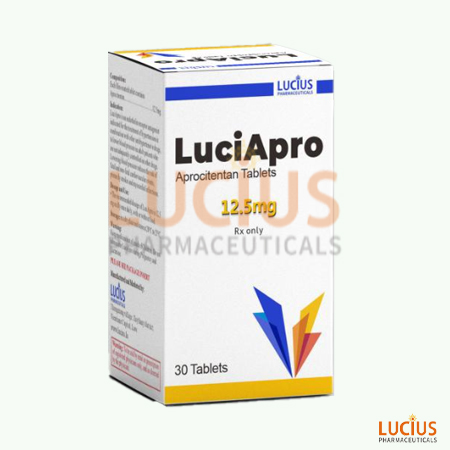
The development of Aprocitentan can be traced back to Bosentan, a dual ETA and ETB receptor antagonist developed by Roche, and the drug specification produced by Lucius is 12.5mg/30 tablets.
Aprocitentan is an oral small molecule that targets dual endothelin A/B receptor (ETA/ETB) antagonists, effectively inhibiting the binding of ET-1 to ETA and ETB.
Aprocitentan is an oral dual endothelin A/B receptor (ETA/ETB) antagonist. This antagonistic effect can block adverse reactions such as vascular constriction, myocardial hypertrophy, vascular smooth muscle cell proliferation, and fibrosis mediated by ET-1, thereby reducing blood pressure and improving cardiovascular function.
Aprocitentan
Aprocitentan combined with other antihypertensive drugs for the treatment of hypertension.
Available data from reports of pregnancy in clinical trials with Aprocitentan are insufficient to rule out a drug-associated risk of major birth defects, miscarriage or other adverse maternal or fetal outcomes. Advise pregnant patients of the potential risk to a fetus.
There are no data on the presence of aprocitentan in human milk, the effects on the breastfed infant, or the effect on milk production. Because of the potential for serious adverse reactions in breastfed infants, advise women not to breastfeed during treatment with Aprocitentan.
Based on data from animal reproductive toxicity studies with other ERAs, Aprocitentan can cause fetal harm, including birth defects and fetal death, when administered to a pregnant patient and is contraindicated during pregnancy.
The safety and efficacy of Aprocitentan in pediatric patients have not been established.
No dose adjustment is required in patients over the age of 65 years.
No dose adjustment is required in patients with mild to severe renal impairment (eGFR ≥15 mL/min).
No dose adjustment is required in patients with mild hepatic impairment (Child-Pugh class A).
Aprocitentan has been administered as a single dose of up to 600 mg, and as multiple doses of up to 100 mg daily, to healthy subjects (48 and 8 times the recommended dose, respectively). Adverse events of headache, nasal congestion, nausea, and upper respiratory tract infection were observed. In the event of an overdose, standard supportive measures should be taken, as required. Dialysis is unlikely to be effective because aprocitentan is highly protein-bound.
Store at 20ºC to 25ºC (68ºF to 77ºF); excursions permitted from 15ºC to 30ºC (59ºF to 86ºF). Store in the original package. Dispense to patient in original container only. Replace cap securely each time after opening. Do not discard desiccant. Protect from light and moisture.
The absolute oral bioavailability of aprocitentan is unknown. The time to reach Cmax is between 4 and 5 hours after administration of 25 mg aprocitentan (twice the recommended dose).
from FDA,2024.03
